
Get free SAT & ACT tips delivered weekly
Thank you! We got you!
Oops! Something went wrong. Try again!


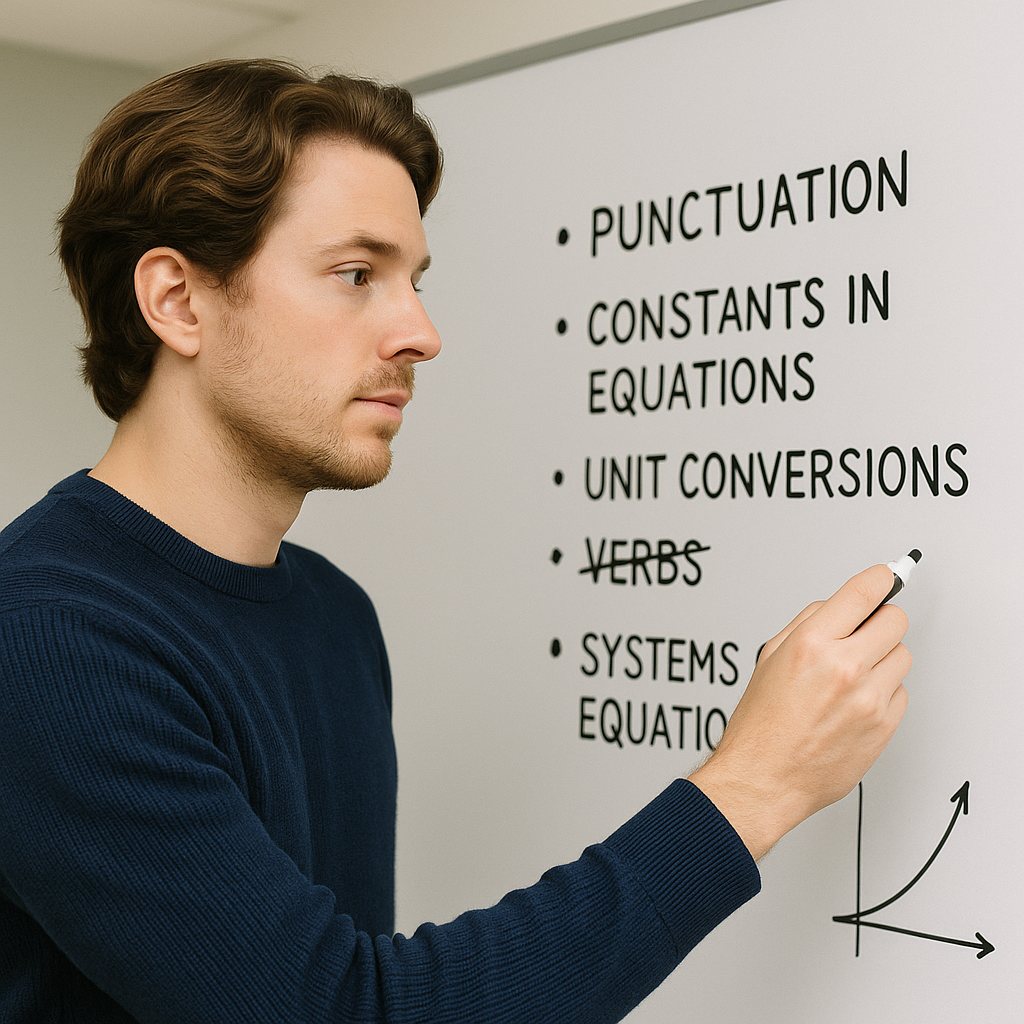
With the December SAT coming up, a lot of students are asking us what is going to be on the test. We cannot see the future, but we can look carefully at the past. By analyzing leaked copies of recent digital SAT administrations, we have been tracking clear patterns in the kinds of questions that keep showing up. Based on that analysis, here are nine things we strongly expect to see on your upcoming SAT and what you should focus on as you prepare.
Most students are used to punctuation questions being about basic rules: commas, periods, and semicolons. Recently, though, the test has started using punctuation to change the meaning of a sentence, especially with transitions like however. The key idea is:
You must ask, “What is being contrasted with what?” and choose the punctuation that creates the correct relationship.
In Math, there is a recurring question type where you are given an equation involving a variable and a constant, and you are asked: “What value of the constant makes this equation have no solution?” The main trick is:
These problems look intimidating at first, but once you recognize the pattern, they become quick and mechanical.
Questions about how to punctuate titles and names are very common. The rule that matters most is whether the name is essential or non-essential information. Here is the shortcut we see tested again and again:
Almost every time on the test, the correct answer is the one that does not put commas around the name.
Regular unit conversions (yards to miles, feet to inches, and so on) show up constantly. The twist we keep seeing is when the test uses area instead of length, which means squared units. This is where many students fall into a trap:
Divide by 1,760², not just 1,760.
As long as you remember to square the conversion factor when the units themselves are squared, these questions are very manageable.
On the Reading and Writing side, verb formation questions increasingly rely on fake main verbs: words that look like they should be the main verb of the sentence but actually are not. The pattern works like this:
The tempting wrong answers are fully conjugated main verbs (like resulted), but what you actually need is a non-finite form (like resulting).
The solution is to read all the way to the end of the sentence and identify the real main verb before choosing the form that goes in the blank.
Another very common pattern is a system of two linear equations that has no solution. The important fact is:
So the quickest strategy is to:
Every recent test we have studied includes at least one dangling modifier question. These usually look like: Introductory phrase + comma + blank For example: “A theoretical relationship between tax rates and revenues, ___” The rule is simple and heavily tested:
If an answer choice places a person or unrelated noun after the comma, that choice is wrong.
Once you get used to asking, “Who or what does this phrase describe?” these become some of the easiest points on the test.
Standard deviation shows up on almost every administration now. The good news is that the SAT is not asking you to compute the formula by hand. A typical problem will:
Ask which value of a constant would make that comparison true.
On the digital test, you can use Desmos to:
Once you are comfortable using Desmos like this, these questions become more about testing your setup than your raw calculation skills.
Rhetorical synthesis questions give you a set of research notes and a specific goal, such as explaining an advantage or choosing a sentence that best matches a purpose. Most of the time, the best strategy is to:
However, on some recent tests, we have seen questions where two answers both meet the stated goal, but only one is factually correct according to the notes. In those cases:
So if more than one answer choice seems logically correct, that is your signal to check the research notes for factual accuracy.
These are not random guesses. They are patterns that have shown up repeatedly across recent digital SATs that we have reviewed. To make the best use of them:
You will not know the exact questions ahead of time, but if you focus on these patterns, you will recognize the way the test is written. That is the closest we can get to seeing the future of your SAT.
If you want personalized practice questions, full-length tests, college admissions tools, study plans, and AI-powered tutoring all in one place, sign up for free at Preppinbee. Your students — and you — deserve tools that make preparation easier, smarter, and more effective. Join for free at Preppinbee.com and start preparing with confidence.